Back to Angola - a book about a reluctant conscript and a 1500km bicycle ride from Cuito Cuanavale in Angola to Tsumeb in Namibia.
Wednesday, April 23, 2014
Voices of Africa website features an extract from Back to Angola
The Mail and Guardian's Voices of Africa website features an extract from Back to Angola today. Click on the link to read a little about the hospitality I received deep in the Angolan bush. Here's a taster:
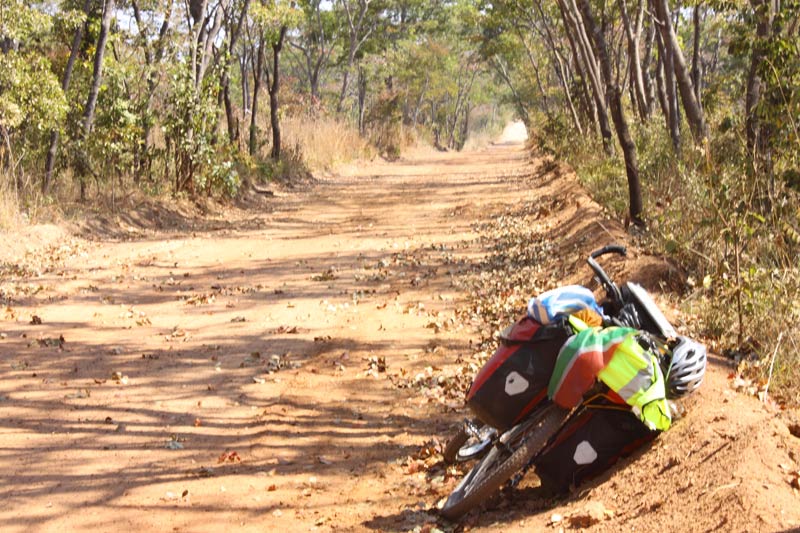
"As I move further into the floodplain, I come to the first of several river crossings. A series of channels cut the road. If I were on an unloaded bike I would simply ride across, but I don’t want to risk a soaking, especially because of my camera equipment. A more critical consideration is that a fall could result in injury. I get off the bike and take off my shoes and socks. The water is cold and clear and I can see what I’m placing my bare feet on as I wheel the bike across. On the other side I lay the bike down and put my shoes and socks back on. I repeat the process again at the next crossing.
There’s a man walking next to the road as I put on my shoes after a third crossing. As we talk I realise how weak I am. I struggle to form words and can’t seem to think straight. I’m in worse shape than I thought I was. I sit for a while on the side of the road, feeling frustrated at my slow progress. Hauling myself to my feet, I walk over to a little ford and kneel next to the river to splash my face. I feel like lying in that cold water and letting it wash away whatever poison is debilitating me.
The sun is lowering in the west. I’ve long resigned myself to the fact that I won’t make Cuchi. I’ve been pushing myself, but I can’t go on like this for much longer. It looks like I’m going to be spending the night in the bush. I start riding again and as I crawl along the broken gravel I scan the bush for a potential campsite. I haven’t seen many landmine signs on this road, but the lack of red-and-white warning signs doesn’t mean that there aren’t mines."
Sunday, April 20, 2014
Dogfights and Dreams - A Mirage pilot's story
This story first appeared in the Aviation News Journal May/June 2014 (Canada)
(Also posted on Wandering. Not lost.)
The first time I heard Arthur Piercy’s story was in 1987 when I was a 20
year old infantry conscript deep in the Angolan bush. I was part of a force involved in South
Africa’s last big invasion of Angola. We’d
watched the aging aircraft of our air force singe the tree-tops as they roared
overhead before “toss-bombing” the Angolan brigades we were about to
attack. At other times we would watch
the Angolan MiG 23s as they circled high above the forests searching for our
positions. We knew that the Mirage F1,
the SAAF’s main fighter aircraft, was no match for the more advanced Soviet MiG
23.
Under the cover of the trees and camouflage nets our commander told the
assembled platoons that one of our Mirages had been shot down and the pilot had
been badly injured during a crash-landing.
25 years later I met the pilot in a coffee shop in a mall near South
Africa’s capital city, Pretoria. I had
stumbled across him again on the internet just before I was about to embark on
a journey back to the battlefields of Angola
to deal with some of my own history.
Arthur was unwittingly part of that history and in a way, I was part of
his. So I contacted him and arranged a
meeting.
We sat opposite each other in a mall, sipping coffee and exchanging war
stories as modern South Africa went about its shopping around us, two war
veterans from another time and a forgotten war.
I’ve heard many war stories, and I’m no stranger to the intensity and
fear of the battlefield, yet as Arthur relates the story of the dogfight that
put him in a wheelchair, I find myself breaking out in goose-bumps. It’s clear that as he tells me about engaging
with the MiG23 at 1600 kilometres per hour, that he is reliving every second of
the fight. The adrenaline surge as he
turns his Mirage around to face the Mig that has just screamed through the
centre of his formation. Flipping his
weapon’s safety switch to “cannons” and then the moment when the MiG fires the
heat-seeking missile. “There was a
bright orange flash from his left wing and then this incredibly fast telephone
pole came hurtling towards me trailing a solid white smoke trail. What’s more
is that it was cork screwing so I was never sure where it was going.” He’s been trained to fly directly at the
missile. It causes difficulties for the
missile’s tracking system. He needs
every ounce of his willpower to keep his aircraft on a head on course with the
thing that is trying to kill him. But he
manages. “I kept breaking towards it and
I watched it corkscrew over my right wing and disappear.” There’s a faint explosion behind him and the
aircraft shudders slightly.
The way Arthur describes the dogfight I almost feel as though I’m in the
cockpit with him; it’s a mixture of
excitement and sour old adrenaline, like a bad taste in my mouth, from my own
memories of battle. I’m with him heading
for the ground at full throttle, I’m with him as he wrestles the aircraft out
of the dive and levels off just above the tree-tops l and races towards home-base
in Runde, so low that he hopes he isn’t creating a dust cloud for the MiGs to
follow.
He goes on to explain the calculations he has to make about fuel
consumption to enable him to nurse his stricken Mirage back to the Rundu air
base. He is losing fuel due to the damage caused by the missile. Once out of danger from the enemy he climbs
to an altitude that will extend his aircraft’s range. In the end he makes it back but with a
terrible problem. The tail of the Mirage
is damaged. The drag-chute, which will
slow him down on landing, has been blown away by the exploding missile. Without the chute the F1 overshoots the
runway and eventually comes to a halt after crashing through the perimeter
fence. Unfortunately the ejector seat
malfunctions, spitting Arthur out of the cockpit and onto the ground where he
lies, still attached to the seat.
He’s badly injured and the fire-fighters rush to help him but he tells
them to attend to the burning airplane.
The flames behind the air intake are dangerously close to the hundred
rounds of cannon ammunition. Arthur
doesn’t want to be shot by his own aircraft.
He wakes up ten days later in hospital.
He will never walk again.
The second time I meet Arthur is at the South African Air Force museum near
Pretoria. The
museum coffee shop looks out at the apron on which stand a selection of
geriatric airplanes. Among them is an
old Impala trainer and an Avro Shackleton maritime search and rescue aircraft
used by the South African Air Force from 1957 until 1984.
I’m meeting Arthur to find out more about his Dreamwings project and,
more specifically, to see the specially adapted airplane he is building. To regain his private pilot’s licence he has
to demonstrate that he can get behind the controls without assistance. When we drive over to the hangar to see his
airplane I notice that it takes some effort, although he’s well practiced, for
him to transfer from his wheelchair to the car seat which is at a similar
height. How difficult will it be, I
wonder, for him to get into an aircraft?
The car is specially adapted so that all the controls are operated by
hand and the aircraft will be similarly easy for him to operate.
When I see the aircraft, I
realise why he has chosen the four-seater Seawind amphibian. The half-finished ‘plane is squeezed into the
hanger between old military spotter planes, a transport helicopter and even a
more modern Rooivalk attack helicopter. With
its high-level wing and the engine mounted on the tail-fin, the Seawind is low
to the ground and, as he is building it from a kit, he has modified it with a
special door in the side of the cockpit to facilitate easy entry. It seems perfect. Equally important is the fact that the
aircraft has a range of over 900 nautical miles, a good long range which will
be essential if Arthur is to fly it around the world. The fact that he can land it on water adds an
element of versatility
Remarkable as it may seem for a quadriplegic to be restarting his flying
career again, what is more remarkable is that Arthur intends to fly the Seawind
around the world on a mission to promote peace.
And at the risk of sounding like one of those awful shopping channel
advertisements: there’s more. Through a third party, Arthur has managed to
get in touch with the Cuban pilot who shot him down. His hope is for the pilot, Major Rivas, to
fly a leg of the journey with him: a reconciliation of former enemies. Having recently met several former liberation
fighters who were active on the same battlefields as me, I understand how such
a meeting can help an ex-combatant to put the past to rest. I can tell by the turn our conversation takes
that he is itching to discuss the ins and outs of aerial combat with the man
who pulled the trigger on that telegraph pole!
As with so many dreams, Arthur needs to raise funds to pay for
completing his aircraft and to embark on his around the world flight. This amounts to a substantial sum of money and
will, in all likelihood, require the assistance of a large corporate
sponsor. Until then, his Dreamwings
project will remain just that, a dream.
For more information or to contribute to the
funding of Project Dreamwings, visit Arthur’s website: http://www.projectdreamwings.co.za/
Sunday, March 16, 2014
Writer Rachelle Greeff reviews Back to Angola in Rapport
"Jy sou tereg kan vra of die Suid-Afrikaanse boekebedryf nie oorversadig
is aan oorlogboeke nie. Ja, maar wanneer hulle van dié kaliber is, nee.
Die prismatiese aard van Back to Angola stel ’n nuwe standaard. Dis
reisverhaal én oorlogvertelling. Net so vlot wissel dit tussen op die
fiets en in die Ratel. Die militêre aspek lê grensloos langs
introspeksie en nabetragting. In ’n mate verklaar dit ook iets van die
padwoede, huisgeweld, onverdraagsaamheid, dwelm- en drankmisbruik
waarvan ons elke dag hoor – of voel"
Read the full review here: http://www.rapport.co.za/Weekliks/Nuus/Boeke-Vrede-met-die-verlede-20140315
Tuesday, February 11, 2014
Saturday, August 10, 2013
Impressions from Cuito Cuanavale
( A version of this story was published in the Sunday Times Travel Weekly - 10 August 2014. A more detailed account of my visit to Cuito Cuanavale - and other places in Angola - can be found in my book, Back to Angola.
A multitude of coloured buckets and
bowls bloom in the sand next to Cuito Cuanavale’s high street. The sight is as refreshing as a spring flower-bed. And like a flower-bed they wait for water. Down by the river, a water- truck is sucking
water from the Cuito River to fill those containers and water tanks around the
town.
I am at the site of the last major
battle that the South African Defence Force fought in Angola. Cuito Cuanavale, a town considered strategic
during the war, is situated some 300 kilometres north of the border with
Namibia. It marked the end of government
controlled territory. To the south,
Jonas Savimbi’s UNITA rebels were in control, supported by the SADF. The outcome of the battle is still disputed,
but whatever your view, most will agree that Cuito Cuanavale was reduced to
rubble during the fighting.
Our Land Rover crosses the post-war
bridge and we trundle down to the riverbank below where some men are washing
their cars and motorbikes. It seems like
a futile exercise in a town where the high street is surfaced with sand. Yet in a place so haunted by the horror of
war, this most mundane of activities is one of many I witness that shows people
are getting on with their lives ten years after the end of the war. I join some of the men by stripping off and
washing several days of travel-dust off my body in the cold river. As I stand thigh deep in the water, rinsing
soap suds from my hair, a fisherman poles past in his makoro, known in Angola
as a chata or canoa.
Further on, the long, brown
flood-plain grass doesn’t quite conceal the rusting dome of a tank’s
turret. I take a picture of an
anti-aircraft vehicle, its cannons still pointed to the sky. The remains of an abandoned pontoon bridge lies
rusting in the silt below the road.
We drive east past an outlying settlement, the
Land Rover growling its way through the deep sand track into the Tumpo
Triangle. This area was first pointed
out to me as we drove past Cuito Cuanavale Airport which sits high on the Cuito
ridge. “Down there,” said Patrick, our
expedition leader pointing to the east, “that’s the Tumpo Triangle, where the
South African tanks got caught in the minefield. It must have been hell for them.”
A man in his late twenties is our
guide to Tumpo. He tells us that he
looked out over the flood-plain during the siege. He was seven years old. He and his family sheltered from the
bombardment in underground shelters. His
grandmother and several other close relatives were killed by South African
shells.
We round a slight bend in the track
and come nose to nose with a Halo Trust truck.
The Halo Trust is the non-governmental organisation, once patronised by the
late Princess Diana, which clears minefields in many of the world’s past and
current war zones. The truck is packed
with people returning from a long day of lifting mines. There’s an impasse. Neither we nor they are keen to leave the
track to allow the other to pass. If the
Halo Trust crew is nervous about leaving the track then so am I. Our guide is jittery. He’s from Cuito and knows the dangers of
landmines all too well. “Don’t leave the
road!” he warns. Eventually the drivers
compromise, each with a set of wheels on the track and the other set off
it. The two vehicles pass so closely
that at one point I fear that the massive truck will tear the side off our
Landy.
A little further on we stop at a
small parking area, a clearing just off the track. It is marked out by neatly placed stones. There’s a little thatched shelter and a Halo
Trust sign. I gaze to the east, towards
the tree line. It’s where the South
African assaults came from. Occasionally
a gentle breeze brushes the blonde grass.
The cooling Landy engine ticks away behind me. What I’m looking at is just bush. It’s quiet and peaceful here and in another
part of Southern Africa I could be scanning for elephant, or kudu or even lion,
but this place holds memories of war and the predators are buried in the
sand.
Patrick suggests that we follow the
little footpath that leads from the parking area off into the bush. He tells us that there are SADF tank wrecks out
there. He’s been to them before and
thinks he can find them again. One by
one we shake our heads. Our guide
doesn’t know where they are, he’s never been.
As for me, the last time I was in Angola I had some near misses. It’s probably safe on the footpath cut by
the Halo team, but I have no intention of being blown to bits by a land-mine
twenty-five years after my war here ended.
Back in town we pull over to buy
some supplies at a little general store.
Like many of the buildings here it is made from grey breeze-blocks. It’s hot inside and some children are
watching a soap-opera on an ancient television set. We buy our essentials and leave. The children
don’t flinch from the screen. When we
start off again Patrick has to engage low range to get us out of the deep sand
next to the road. I find myself
wondering why money has been put into building a new airport when the residents
have no running water. Why an expensive
war monument has been built when electricity comes from small generators. So much effort has gone into creating a
“peace garden”, ironically full of tanks and rocket launchers and even a MiG23 fighter
jet, when one needs a four by four just to pull off the high-street. These questions are echoed by several Angolans
I meet later in my journey. People here
are resilient, they have to be, but there are murmurs of dissent.
As in many countries, the
marketplace is the hub of the community and Cuito’s colourful little market
represents a community getting on with life.
Patrick is in search of fresh fish and I’m looking for fresh vegetables
for my dinner. I don’t speak Portuguese
so I wander around plucking up the courage to ask for prices. Eventually I buy a selection of delicious
looking vegetables including tomatoes, onions, garlic and peppers. Other stalls sell t-shirts and baseball caps,
rucksacks and household implements. The
market is busy and it seems that there’s not much in the way of daily
necessities that one can’t buy here.
Patrick can only find dried fish
though. “You have to get up very early
in the morning and go to the river at about six o’clock if you want fresh fish,”
our host informs him. It’s too early so he doesn’t get his fresh,
Cuito River, fish.
Once Cuito Cuanavale was a scene of
devastation, and the war still clings to it in the form of military wreckage
and bad memories. Yet, as people do
everywhere, the inhabitants are rebuilding their town and living their lives,
blooming like those colourful buckets in the Angolan sand.
Friday, June 21, 2013
Legacies Of Apartheid Wars Conference - 4 - 6 July 2013
There will be a unique conference as part of the South African National Arts Festival's Think!Fest this year.
The conference is bringing together ex-concripts, ex-liberation fighters, informal township fighters, family who lost loved ones as well as others affected by the wars of the Apartheid era. There are also offerings from the arts and I will be talking about my bicycle journey.
With a national debate that seems increasingly polarised, this conference is going a long way towards contributing to a more constructive national dialogue.
Ex-combatants are again putting themselves on the front line, but this time in the service of peace.
http://www.lawsconference.co.za/
LAWs on Facebook
The conference is bringing together ex-concripts, ex-liberation fighters, informal township fighters, family who lost loved ones as well as others affected by the wars of the Apartheid era. There are also offerings from the arts and I will be talking about my bicycle journey.
With a national debate that seems increasingly polarised, this conference is going a long way towards contributing to a more constructive national dialogue.
Ex-combatants are again putting themselves on the front line, but this time in the service of peace.
http://www.lawsconference.co.za/
LAWs on Facebook
Wednesday, March 13, 2013
Upcoming Event: A Talk and some slides at Rhodes
I will be talking about my journey and showing some slides next week at Rhodes University.
Please come along if you have an interest in the "Border War", peace-making, healing journeys, post-traumatic stress or dialoguing about the effects of South Africa's past on the present. Cyclists also welcome!
Date: Tuesday, 19th of March
Time: 1600
The venue is to be confirmed.
This is a History in the Making seminar in partnership with the Legacies of Apartheid Wars Project
http://legaciesofapartheidwarsproject.wordpress.com/
.
Please come along if you have an interest in the "Border War", peace-making, healing journeys, post-traumatic stress or dialoguing about the effects of South Africa's past on the present. Cyclists also welcome!
Date: Tuesday, 19th of March
Time: 1600
The venue is to be confirmed.
This is a History in the Making seminar in partnership with the Legacies of Apartheid Wars Project
http://legaciesofapartheidwarsproject.wordpress.com/
.
Subscribe to:
Posts (Atom)
