Tuesday, July 26, 2011

Ways of Remembering

My letter to Beeld, the Afrikaans language newspaper, was published today.  In it, I said I thought the musical Tree Aan! was a sanitised and sentimental depiction of life as a conscript.  I also remarked on the striking similarities between this production and Somewhere on the Border, a 1980’s play by Anthony Akerman.  I have heard others say the same on both counts.

It is difficult to explain one’s thinking fully in the short space of a letter to the editor.  I thought it would be useful to clarify some of my comments here.

First of all, my main concern is not the similarities between the two productions.  The similarities merely make a comparison easier.  I know nothing about theatre, I’m an occasional theatre-goer, but I did think the two productions were close. 

While the main characters seem almost identical, they are often played differently.  For example:  the Jewish soldier, the bully, the English speaker who has doubts, a black base-worker who later morphs into a liberation soldier and a character who dies in action.  Deon Opperman adds a lieutenant and a girlfriend for romantic interest, which is where the two productions look very different.

One could say that a journey through military service described in a 2 hour (or thereabouts) stage production is likely to look similar.  National Service in the 80’s was a fairly predictable formula.  And Hollywood has produced films that follow recruits through training and into action.  Here I think of Full Metal Jacket, Hamburger Hill etc.  Others focus in on training e.g. Tribes, and many have chosen to take the audience straight into the war zone, e.g. Saving Private Ryan. 

My surprise did come only after I’d seen both productions, when I was told that Opperman was in the original cast of Somewhere on the Border.  I thought he might have decided to take another way of portraying the military sausage machine to make sure he avoided comparisons being made.  I suspect this may be of more interest to theatre critics and those in the business.

I went to see Tree Aan! because I knew I was going to Somewhere on the Border in Grahamstown the following week.  I was interested to see how an ‘80’s play compared to a contemporary interpretation of that period.  As it turned out, the ‘80’s play was the more powerful of the two by a country mile.  In the foyer afterwards, myself and two other border war vets stood shaking with the impact of the play.

Somewhere on the Border took me back to the bungalow at 1SAI in Bloemfontein, and off to my tent on the border.  The language was the foul, misogynist, sexualised swearing I remember all too clearly.  The Permanent Force corporal was, like so many I had the misfortune to be trained by, a nasty, sadistic piece of work who victimised those who were different.  Racism was ever present in its ugliest form (I was called a kaffir-lover for reading Andre Brink).  There was no tolerance towards those who questioned the morality or politics of what we were doing.  Ultimately Somewhere on the Border demonstrates how powerful the SADF was at moulding us to their needs.  The “total institution” wore most of us down in the end and we bowed to the authority of our commanders and did the bidding of their Apartheid masters.

By contrast, Tree Aan! is clearly designed as family entertainment and it succeeds.  By all accounts it has been playing to packed houses and when I saw it, standing ovations.  It glosses over a brutal, violent and morally dark period in South Africa’s history.  For me the only real jolt came when the list of those conscripts who died in action was projected onto the curtain at the end.  Some may say that it was a cynical ploy to generate tears.  Well, for me it worked.  I recognised some names of young men I’d fought with in Angola.

Tant Sannie would barely raise an eyebrow at the language or indeed any of the themes.  And that, I suspect, is Mr Opperman’s aim.  Like so much coming out of Hollywood, it is designed to make money.  Many will say that there is nothing wrong with that.  But in a South Africa still struggling to come to terms with a difficult past, this kind of nostalgic look back does little to add to the possibility of healing for ex-conscript war veterans and society at large. 

The SADF gave us no space for coming to terms with what many of us saw or did.  When I came out of Angola my mortar firegroup got less than an hour with an industrial psychology honours graduate:  a woefully inadequate debriefing.

There is a sense that we are beginning to talk about our experiences.  And we need to be able to tell our stories without censorship.  Many of us have censored our stories for decades.  My concern is that Tree Aan! regurgitates the myths and lies of the time, closing down the space where veterans can start talking about what really happened.  We were involved in what was often a very dirty business.  Some of us committed atrocities or stood and watched while others did.  Many went off to the army with deep reservations.  Still others believed implicitly in the cause and returned deeply disillusioned.  We need to find a healing path, and repeating old lies is not the way.

One of the final lines of Opperman’s musical is crucial:  (apologies if this isn’t exactly right) “who will remember us in 20 years?”  There are different ways of remembering:  A way that allows us to be honest about what happened up there and allows us a way of making some measure of peace with our present, with ourselves and the country we live in today.  Or a way that locks us into the past, a way that denies the difficulties of the time, and colludes in suppressing the pain many still feel.

Friday, July 22, 2011

The Journey Home - by Steve de Witt

[I am very grateful to Steve for writing this eloquent and powerful article about his experience of combat and his own journey home;  the journey that has brought him back to the fullness of his humanity.

Steve was in an infantry platoon based on the Namibia/Angola Border a few years before I was there - Paul]

Your first combat experience profoundly impacts your life. No military training fully prepares you for the sudden intensity and violence. It’s a shocking experience that momentarily paralyses you, then turns you into a killer. That’s the reality – you must kill the enemy before he kills you. It is some experience to be the one still standing afterwards, a man dead at your feet. It was you or him, and you prevailed.

The bush is quiet afterwards, and a series of emotions wash through you. Astonishment, elation, horror, pride, regret. Your comrades congratulate you quietly, search the body, then wander away. Suddenly you’re alone with your thoughts. You sense you’ll never be the same again.

And you never are. You’ve just taken an exponential leap away from the person you were only minutes before. You have crossed into the dark side. Once there, you’re part of a foul brotherhood, the killers of people. And it just gets worse. A long war looms ahead, more death beckons, and you’re one of its proven agents. In this world, others hold you in awe, spurning a corrupted pride. Your morality is the next casualty, followed closely by your soul.

So we became a band of unhappy brothers, effecting death casually in the end and preying on the weak. I’d entered the dark night of my soul. It was a frighteningly long night. We had many perilous adventures and committed countless grave misdeeds. Along the way we lost some of our own. This was another order of profundity, dealt with by heavy drinking and emotion suppression. Besides, there wasn’t time to linger. Tomorrow there were more people to hunt and kill.

Suddenly the war was over and I was ejected into the normal world.

And so began the Journey Home. It’s the journey back to your self, the rekindling of your humanity, the discovery of your compassion. It takes decades but at some point you feel healed, and you realize what’s happened on the journey – that you’ve forgiven yourself, and started to make amends.

I thought I’d killed that first man thirty years ago. I realize now that he actually took my life away. I’ve only now, decades later, resurrected my scarred self into someone new. Paul, my brother-in-arms, may you travel safely on your own journey and come home soon. There’s a place by the fire for old soldiers like us. Here our stories are significant to those seeking their own way in an uncertain world.

Monday, July 11, 2011

My Heart of Darkness - a movie

There are many different experiences of war and many ways of dealing with its effects.  Not everyone’s post-war journey follows a healing path.  While some may look to psychotherapy and others take a spiritual journey, many have resorted to the oblivion of alcohol and drugs. 

Marius Van Niekerk has made a remarkable and compelling movie about part of his own journey.  Returning to Angola, the ex-paratrooper meets up with three other war veterans to undertake a journey through the beautiful Angolan landscape;  a beauty in stark contrast to the horror of their stories.  The men had fought on different sides: a FAPLA soldier who had fought for the Angolan government, a UNITA soldier who had fought for Savimbi’s rebels, and a Bushman soldier who had fought for both the Portuguese colonial army and later the South Africans.

In a parallel to Joseph Conrad’s story, the four men make their way up an Angolan river by boat and travel deeper into the darkness and horror of their respective pasts as they go.

During the course of the private screening in Grahamstown I found myself feeling shocked, horrified, moved to tears and finally left with feelings of hope.

My Heart of Darkness is to be premiered in South Africa later this year.

Follow this link to see a trailer of My Heart of Darkness: http://www.youtube.com/watch?v=DJxX6ShOO9w

Tuesday, June 21, 2011

Cycling Africa

I saw this painting last week as I sat at the traffic lights on William Nicol Drive in Johannesburg.  Yesterday I saw it again, and bought it.  Painted by Richard Kupeta, a Zimbabwean who sells his art between the cars when the lights are on red.  This photo doesn't do justice to the vibrancy of the colours.  I thought I'd share it anyway.

Thursday, June 16, 2011

Vineyards and Single-tracks and Stories for Healing

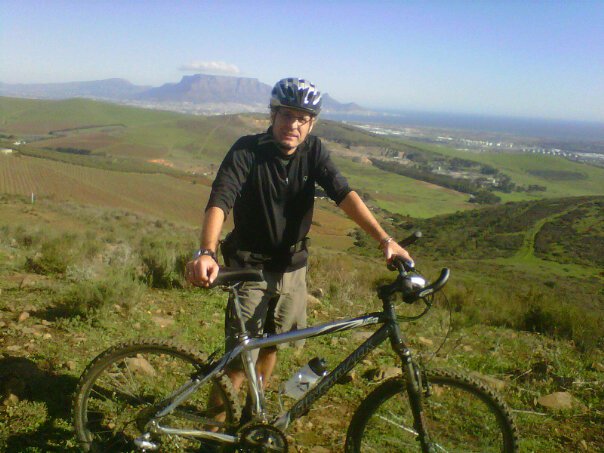
I don’t think about the war when I’m cycling.  Especially when I’m riding my mountain bike on a single-track.  When I was new to mountain biking I’d try to take in the view but would nearly come to grief in a ditch or would trundle off the path into the long grass.  Now I watch the track, or the back wheel of the bike in front.  I do this because I don’t like falling off.   It hurts.  There’s no time to think while I’m mountain biking, I’ve discovered.

Recently I rode into the vineyards with a friend.  Altydgedacht Estate is almost across the road from my house.  I didn’t think of the war as I rode between the autumn vines, their leaves turning first yellow, then burnt orange and finally deep autumn red.  The wasted grapes unharvested from the summer in piles of pleasantly wine-smelling heaps.  The only thing on my mind was the sheer joy of being out in the Tygerberg hills on my bike with an old friend.

My lungs burn and my heart thunders in my chest and suddenly we are haring down towards Bloemendal Estate, over to Nitida, around the top of Hillcrest with its rows of olive trees laden with black olives.  More pain and eventually, after some middle-aged bike-pushing, we reach the telecommunications masts. 

On top of the Tygerberg there is only one place to be with the panorama that stretches out in all directions:  The Present.  My body feels as if it’s celebrating, my mind is alive and awake and interested only in seeing Cape Point, Table Mountain, Robben Island and the distant Dassen Island.  Below is the patchwork of vineyards that have exhausted themselves in the cycle of growth that will produce some of my favourite wines.  We head down to Meerendal and then home. 

Not so sitting at my desk in Johannesburg.  I’m looking at some notes sent to me by James Clelland following a recent meeting.  The notes lay out themes we might discuss at the National Arts Festival in Grahamstown next month.  I’m wondering about whether I want to talk about my part in killing, mutinies in the bush and the homosexual experiments of some of the guys. Guys who would without a doubt identify as heterosexual.  I’m not sure I want to talk about these things to an audience of strangers.  These are stories of pain and shame, grief and fear;  stories to be shared with buddies who were there, not strangers at a book event.

I mull this over all day.  I cut a gym session short because my energy is with the thinking and not with the working-out.  Unlike cycling the gym is monotonous, boring and my mind takes itself for a walk.  I take my problem for a walk around Zoo Lake.  Two laps.  The sun is setting, braai fires are gently smouldering their last as groups of friends finish eating and pack up to leave.  A group of teenagers are talking about whether one of them is drunk.  None of them look drunk, they’re just kids having a good time.  Kids who weren’t born when I was in the bush.  Born frees.  One moment I’m enjoying eves-dropping, the next I realise, with sadness, that I had fought so that they would be born oppressed.

Maybe I’ll talk about these things after all.  About the death and the nightmares and the mutiny and the friends playing at being effeminate until it becomes something else.  My stories aren’t particularly dramatic or extraordinary or even extreme in comparison to other stories I’ve heard.  But people should know what they sent their sons and brothers and boyfriends off to do.  They supported the system and the culture that put us there, whether by act or omission.  And they should know.  For without the space to tell these stories and to be heard, there can be no healing.  I believe that if we can’t find a healing path to follow for those of us who fought apartheid’s wars, we will not find a healing path for our society as a whole.  Maybe we should stop and look up from the single-track.  The view might surprise us all.

Sunday, May 22, 2011

Questions from Choctaw High School - Oklahoma

My new friends at Choctaw High School in Oklahoma have sent me some questions about my journey.  Here they are with my answers.


My question is: Do you plan to enjoy this trip, or will it be painful? -- Rachel Baack

I expect the ride to be physically demanding for sure.  It’s a long ride with very little in the way of home comforts.  However, my aim is to enjoy the trip as a civilian tourist. Last time I saw Angola it was as a soldier, and Angola was the battlefield.  This time I’m looking forward to seeing the beauty of the place and its people.

What if the trip isn't what you are expecting, are you going to be disappointed? -- Erica Herman

I guess when we follow our hearts and our dreams there’s always the risk of disappointment.  But I think the greatest disappointment would be not to take the chance in the first place. So yes, I may in some way be disappointed.  But I’d rather be disappointed trying than sitting at home wondering!

How long did it take you to realize that you needed to make this journey, and was it hard to finally make the decision to do it? -- Cassandra Velasco

I think I’ve always wanted to go back to Angola in peacetime.  Even when I was in the bush as a soldier, I wondered what it would be like to see that beautiful landscape without the constant fear and fighting going on.  The decision came naturally.  It just feels like the right time, so the decision kind of made itself.  So it was easy.

Do you have any smaller goals for this trip, other than the main ones you talked about in your blog?
-- Hunter Brodrick

There are several things I’m hoping for, aside from the overall goal of “putting ghosts to rest”.  I am hoping to write about my journey, hopefully in book form, but if not, then on my blog.  I’d like to meet some ex-soldiers from the Angolan army so that I can hear about their experiences.  I’d like to tell them I’m sorry that I contributed in a small way to perpetuating that terrible civil war in their country.  And I’d like to contribute to a dialogue in South Africa that encourages other ex-conscripts to speak out about the effects the war had on them and that they can find their own healing path.

Do you feel like your trip will help put other people whose situation is similar to yours ghosts to rest, or perhaps inspire them to take the same journey that you are about to take? -- Brandon Reed

Sorry Brandon, seems I answered your question above! It is certainly my hope. Everyone’s journey is different.  I don’t think it’s necessary for everyone to undertake the journey in a physical sense.  But certainly in an emotional sense.

When on bike you can’t pack as much stuff, what are some of the items you will pack maybe for emergencies, daily life, or recording your journey while packing light? -- Chase Gooch

Well a very good first aid kit is a must.  Including things like needle kits for injections and drips etc.  HIV and Hepatitis can be transmitted by unsterilized needles so I’ll carry my own.  I’ll carry some emergency food in case I can’t get any along the way, eg. If I’m not sleeping in a village.  My camera is very important to me and I can use it for video as well as still photography.  I’ll also need a few notebooks.  I’ll need a Portuguese/English dictionary or phrasebook.  I am debating what shelter to take for when I camp.  Either my lightweight tent or a bivvy bag.  Possibly a mosquito net because this is malaria country.  Wow, this list is growing!  Finally, I will need some spares for my bike.

In one of your very first posts you mentioned that you believe you "fought on the wrong side of a grubby local war" (or so I took it). Is one of your main reasons for going to Angola to put some of your ghosts to rest to go back as a "friend" rather than a "foe"?  -- Rachel Kelley

In short Rachel, yes.  Inner peace and peace with old foes are intricately linked I think.  Governments make enemies out of men and women who would likely be friends if they met of their own accord in more favorable circumstances.

I noticed in Paul's blog he said war is never good. But is that really true? Is it not war that has brought about some of the most powerful technological advances? Is it not war, along with disease, and natural disasters that keep the population in check? War is the only thing that tempers us, and makes us stronger as a species. It is war, and human bloodlust, that keep the species moving forward.  As painful as it is to say it, humanity will never coexist peacefully. War is perpetual.  – Elijah Talmud
I think you may guess my answer to this by now.  I think war requires a culture that supports it.  I think it is similar to a culture of racism and subjugation of one people by another.  Attitudes can change by those of us who disagree speaking out. As individuals we can decide to participate in the changing of that culture to a culture of peace.